Narrow-Body Showdown (Short-Haul Workhorses)
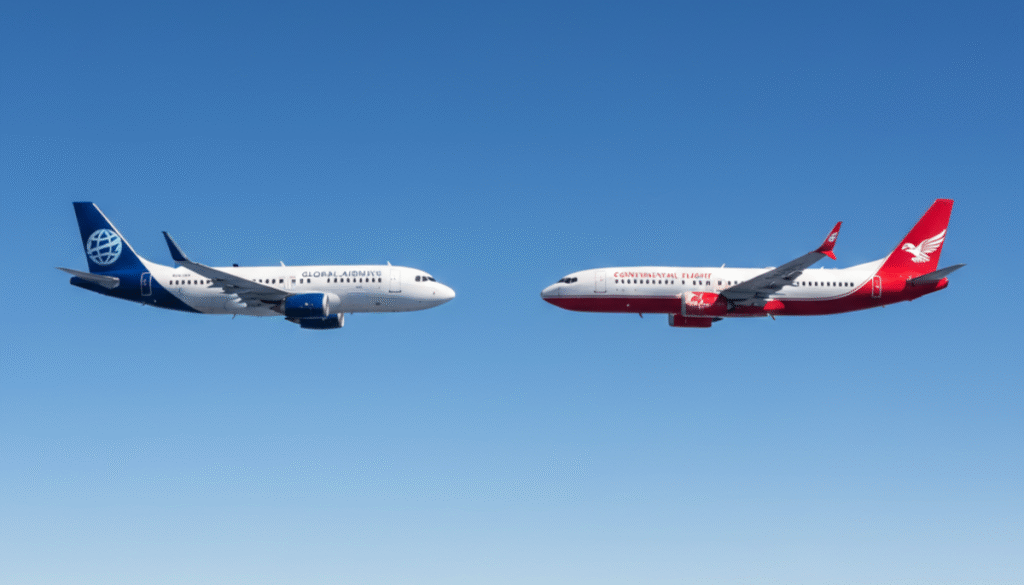
In the workhorse category—the planes you take for domestic or quick European trips—it’s the Airbus A320neo vs. the Boeing 737 MAX.
- Airbus A320neo: This is the marathon runner. Its key selling point is efficiency. It can sip fuel, offering up to 20% better efficiency than the older models it replaces. It’s the cost-saver that keeps airlines happy.
- Boeing 737 MAX: This is the sprinter. While it matches the A320neo’s efficiency, the MAX is known for its muscle. Pilots praise its ability to climb faster and maintain slightly higher cruise speeds. It’s built to get you to your destination just a little bit quicker.
Wide-Body Battle (The Long-Haul Giants)
For the epic journeys—crossing oceans and connecting continents—we look at the Boeing 787 Dreamliner vs. the Airbus A350.
- Boeing 787 Dreamliner: Often hailed as the rocket ship of its category. It’s built on a light composite structure that gives it an advantage in speed and flexibility. It’s designed to be fast, sleek, and adaptable to many different routes.
- Airbus A350: This aircraft is all about range and refinement. The A350 excels with superior endurance, allowing it to tackle some of the world’s longest non-stop routes. Travelers and airport neighbors also love its exceptionally low noise levels—it’s the quiet giant of long-haul travel.
The Bottom Line: Both companies are leading the charge in green aviation, utilizing advanced aerodynamics and lightweight composite materials. Whether you fly Airbus or Boeing, you’re on a cutting-edge aircraft designed for minimal emissions and maximum savings.
4. Safety and Reliability: The Ultimate Trust Test 🛡️
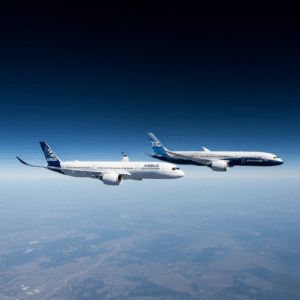
When you board an airplane, nothing matters more than safety. On this front, both Airbus and Boeing maintain statistically exceptional records, racking up millions of safe flight hours every year. But their approach to safety reveals their core philosophies once more.
Safety Philosophy: Trusting the Code vs. Trusting the Pilot
| Manufacturer |
Airbus (Trusting the Code) 💻 |
Boeing (Trusting the Pilot) 🧠 |
| Safety Philosophy |
Automation as the Safety Net. |
Pilot Intuition as the Final Check. |
| Core Principle |
The computer systems constantly monitor and intervene to ensure the aircraft remains within its safe operating limits (Flight Envelope Protection). |
Relies on the human judgment and skill of the experienced crew to manage and overcome challenging, real-world situations. |
| In Practice |
Hard limits prevent the pilot from making any control input that would cause a stall, overspeed, or overstress the airframe. |
The pilot retains full control authority to override automation and make control inputs, even if those inputs temporarily exceed the normal flight envelope. |
| The Result |
High level of operational consistency and a reduced probability of catastrophic human error during normal flight. |
Emphasis on pilot airmanship and the ability of the crew to respond decisively in non-standard or emergency scenarios. |
Airbus: The Consistent Safety Net
Airbus trusts its advanced systems. Its fly-by-wire technology acts as a smart guardian, ensuring that no matter the pilot’s input, the aircraft will always remain within safe operating limits. This computer-assisted approach dramatically reduces the chance of human error leading to catastrophic failure, giving Airbus a reputation for operational consistency and predictable safety.
Boeing: The Crisis and the Comeback
Boeing has always placed its trust in the experience and quick thinking of the human pilot. However, this philosophy was severely tested during the 737 MAX crisis (2019–2020. That period was a stark, temporary blow to Boeing’s otherwise stellar reputation, highlighting a failure of systems oversight rather than just design. Since that difficult time, the model has undergone significant, required system overhauls and has returned to the skies safely.
The Verdict
Statistically, both are incredibly safe. You are in good hands with either.
Airbus earns a slight edge in consistency, thanks to its rigid, computer-enforced safety envelope.
Boeing retains the deep pilot trust built over decades, even after recent challenges, for empowering the human in command.
5. Passenger Comfort: The Traveler’s Priorities
|
Manufacturer |
Airbus (The Quiet, Wide Ride) |
Boeing (The Smart, Scenic Cabin) |
| Primary Focus |
Seat Space, Silence, and Air Quality |
Natural Light, Mood, and Humidity |
| Key Features |
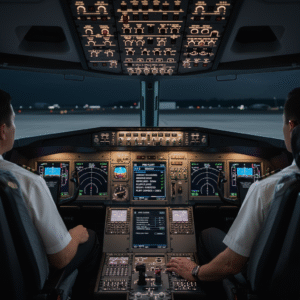
Wider seats (even in narrow-bodies), extremely quiet cabins (A350/A380), and fresh air systems. |
Larger, dimmable windows, specialized LED mood lighting (“sky interiors”), and optimized cabin humidity for reduced fatigue. |
| Passenger Benefit |
Physical comfort, peace, and quiet on short and long journeys. |
Reduced jet lag, better sense of space, and a more engaging visual experience. |
Airbus: Wider Seats and Silence
Airbus has built a reputation on simple physics: **width matters**. Even on the short-haul **A320** (their competitor to the 737), the cabin is designed to accommodate slightly wider seats, which can make a huge difference to your shoulder space on a packed flight.
For long-haul giants like the A350 and the retired A380, Airbus engineers focused on creating a sanctuary in the sky. These planes are famous for their exceptionally quiet cabins and advanced air systems that make the air feel fresher and less dry. If your priority is peace, quiet, and a little extra wiggle room, Airbus is your friend.
Boeing: Windows and Wellness
Boeing took a different approach, focusing on ambiance and bio–wellness. Their flagship, the 787 Dreamliner, is a masterclass in cabin innovation:
Bigger Views: The 787 is instantly recognizable for its massive, electronically dimmable windows—letting you control the light without pulling down a harsh plastic shade.
Sky Interiors: Specialized LED “sky interiors” mimic natural daylight cycles, while better cabin humidity and lower air pressure elevation are specifically designed to reduce jet lag and fatigue.
The Traveler’s Verdict
It’s a true split decision based on what you value most in the air:
Airbus wins on core physical comfort (wider seats, quieter cabins).
Boeing wins on innovative cabin ambiance (better lighting, bigger windows, and anti-jet lag features).
6. Technology and Cockpit Systems: The Pilot’s Office
| Manufacturer |
Airbus (The Digital Command Center) 🖥️ |
Boeing (The Hybrid Workstation) 🔧 |
| Tech Goal |
Total System Integration and Commonality |
Advanced Tools with Pilot Override |
| Philosophy |
Automation is primary; the pilot is the system manager. |
Pilot experience is primary; automation is the assistant. |
| Key Features |
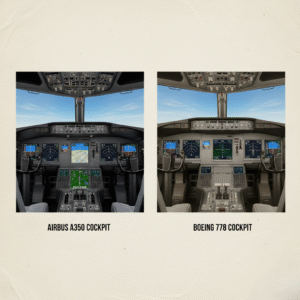
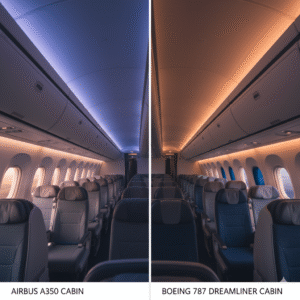
Standardized, uniform cockpit layouts across aircraft families. Advanced Touchscreen Displays (A350) and simplified interfaces. |
Hybrid Avionics System (e.g., 787 Dreamliner) that blends modern tech with traditional, tactile controls. |
| Airline Benefit |
Reduced training time and cost due to a high degree of commonality. |
Maintains pilot authority and a familiar operating environment while still benefiting
from automation. |
Airbus: The Seamless, Unified Future
Airbus was the trailblazer in the digital cockpit. They realized early on that a standardized, highly automated interface would revolutionize pilot training and operation.
Uniformity is Key:
Whether a pilot is flying the A320 or the A350, the core controls and procedures are remarkably similar. This “family commonality” saves airlines millions in training costs.
Touchscreen & Simplicity:
Newer aircraft like the A350 feature advanced flight decks with touchscreen displays and simplified graphical interfaces. The goal is to make the technology so integrated that the pilot becomes a high-level system manager.
Boeing: The Best of Both Worlds
Boeing’s approach has been more cautious, balancing cutting-edge technology with the familiar feel of manual control. They were slower to adopt digital cockpits, but when they did, they engineered them to work *with* the pilot’s established authority.
Hybrid Avionics:
In aircraft like the 787 Dreamliner, you see a hybrid system at work. Pilots benefit from advanced automation, huge display screens, and synthetic vision, but they are still encouraged to rely on their instincts and manual skill.
The Pilot Always Decides
Boeing integrates the tech as a powerful set of tools, ensuring that the human experience remains the centerpiece, ready to take over fully if the computer systems present a challenge.
The Contrast
In essence, Airbus sees the technology as the co-pilot that ensures safety and efficiency, while Boeing sees technology as the pilot’s powerful, yet subordinate, assistant.
7. Environmental Impact and Future Sustainability: The Race to Save the Planet 🌍
This is the final frontier—the race for the future. Boeing and Airbus both recognize that their biggest challenge isn’t just building faster planes, but building planes that don’t cost the Earth. But they’re taking entirely different paths to the finish line.
Airbus: The Giant Leap of Faith (Hydrogen) 🚀
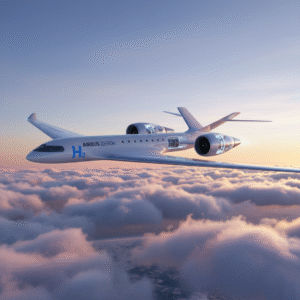
Airbus is the visionary, making a massive, multi-billion-dollar bet on a completely revolutionary future. Their ZEROe project isn’t about small tweaks; it’s about swapping fossil fuels for hydrogen, aiming to put zero-emission commercial jets in the air by 2035. This requires courage, as it means redesigning the aircraft, the engines, and the airport infrastructure itself. It’s the highest-risk, highest-reward plan, positioning Airbus as the leader in long-term eco-innovation.
Boeing: The Smart, Practical Steps (SAF) 🌱
Boeing, ever the pragmatist, is focused on creating immediate, tangible change with the existing fleet. Their EcoDemonstrator program is the proving ground for technologies that work right now. Their core focus is on perfecting the use of Sustainable Aviation Fuel (SAF) and making their planes highly fuel-efficient. The path doesn’t promise “zero” emissions, but it offers a rapid, achievable reduction in carbon output, making Boeing the champion of short-term, practical efficiency.
The Final Verdict: A Two-Track Future
We, the passengers, benefit from both strategies.
Airbus is leading the way to a true, emissions-free dream.
Boeing is ensuring every flight you take today is getting cleaner and greener.
8. Market Share and Airline Choices: The Global Turf War 🌐
This is where the rubber meets the runway: the battle for the airline’s dollar. The competition between Airbus and Boeing is less about one leading overall, and more about who dominates specific parts of the sky.
Airbus: The King of Short-Haul and Volume
Airbus has surged ahead in total deliveries largely due to one massive success story: the A320neo family.
- The Low-Cost Favorite: The A320neo, with its fuel efficiency and the common cockpit design shared across the whole family (A319, A320, A321), is an operational dream for carriers flying high-volume, short-to-medium routes.
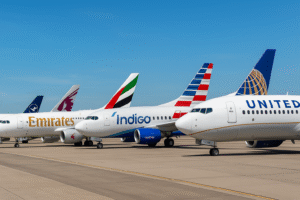
- Global Strongholds: This single-aisle dominance has made Airbus the favorite for fast-growing airlines like IndiGo (India), Wizz Air (Europe), and powerhouse international carriers like Lufthansa and Qatar Airways. They prioritize the lower training costs and passenger-friendly comfort of the wider A320 seats.
Boeing: The Wide-Body Specialist and American Legacy
Boeing’s strength lies in its legacy and its long-haul muscle, particularly with the 787 Dreamliner.
- Wide-Body Dominance: Boeing maintains a commanding lead in the wide-body (twin-aisle) market, which includes the jets used for long, intercontinental routes. The U.S. carriers trust the Dreamliner and the upcoming 777X for their global reach.
- American Alliance: Boeing remains the favored supplier for most major U.S. carriers like United, Delta, and Southwest, and it retains a fierce hold on some low-cost legends like Europe’s Ryanair and key segments in Asia. For these airlines, the proven reliability and established pilot pool for the 737 remain highly valuable.
The Scoreboard: Segment by Segment
| Segment |
Airbus Dominance |
Boeing Dominance |
| Narrow-Body (A320neo vs. 737 MAX) |
Clear Lead (More Deliveries, Larger Backlog) |
Strong in key legacy markets (e.g., U.S. domestic) |
| Wide-Body (A350/A330 vs. 787/777) |
Catching up rapidly |
Clear Lead (Stronger backlog for long-haul jets) |
| Key Customer Focus |
Global low-cost carriers (LCCs) and major European/Asian flag carriers. |
U.S. legacy carriers and long-haul specialists. |
The rivalry is intense, but the good news is that this fierce, segment-by-segment competition forces both giants to relentlessly innovate, which is the healthiest thing for the future of travel.
9. Pilot Opinions
It’s like asking musicians if they prefer a classic acoustic guitar or a modern synthesizer—both are brilliant, but they offer completely different experiences.
The world’s pilots are fiercely split, essentially lining up behind two distinct flying philosophies:
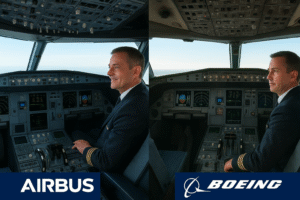
- The Boeing Camp: These pilots are the “hands-on” aviators. They value the traditional yoke (the classic control column) because it gives them direct, tactile feedback and full, manual authority over the aircraft. They feel more like they’re flying the machine, with less computer interference.
- The Airbus Camp: These pilots are the “systems managers.” They love the cutting-edge automation, which makes their work smoother and reduces fatigue. The side-stick controller and highly standardized cockpit across all Airbus models (A320, A330, A350, etc.) is a huge plus, as it means less time and cost for an airline to train them to jump between different planes. They feel safer and more comfortable letting the computer handle the fine details.
In short, it’s the classic divide between those who prioritize direct, manual control (Boeing) and those who embrace advanced automation and commonality (Airbus).
10. The Next Decade of Flight: Innovation and Rivalry in Aviation
The innovations in aviation over the next decade, spearheaded by Airbus and Boeing, center on extended range and efficiency in their new aircraft models, alongside advancements in AI-driven cockpit and autonomous technologies.
Aircraft Innovations
- Airbus A321XLR (Xtra Long Range): This aircraft extends the capabilities of a narrow-body (single-aisle) jet to fly ultra-long distances, creating new, direct routes that were previously only possible with larger, less-efficient wide-body planes.
- Key Features: It offers a maximum range of up to 4,700 nautical miles (non-stop flights up to 11 hours), primarily achieved through a new Rear Center Tank (RCT) for additional fuel and a maximum takeoff weight (MTOW) increase to 101 tonnes.
- Impact: It provides airlines with greater flexibility, lower operating costs, and the ability to “right-size” routes (using a smaller, more efficient aircraft) during periods of lower demand.
- Boeing 777X (777-8 and 777-9): This is a new series of wide-body, twin-engine jets designed for massive capacity and long-haul efficiency.
- Key Features: It introduces a longer, composite wing with unique folding wingtips (to maintain compatibility with existing airport gates) and features the new, highly efficient General Electric GE9X engines. The cabin is also wider with larger windows, drawing on the Boeing 787 Dreamliner’s design to enhance passenger comfort.
- Impact: The aircraft boasts up to 10% better fuel efficiency and lower operating costs compared to its nearest wide-body competitor, making it the new standard for high-capacity, long-haul travel.
AI and Autonomous Technologies
Both companies are exploring technologies to support pilots, enhance safety, and streamline operations.
- AI-Assisted Cockpits and Safety: AI is used in real-time monitoring and pilot assistance systems to mitigate human error, which is a leading cause of incidents. It aids in complex decision-making, such as predicting turbulence or icing conditions, and is expected to eventually lead to a shift from human-in-the-loop to human-on-the-loop operations.
- Autonomous Flight: Near-term efforts focus on improving the safety and efficiency of flight operations rather than immediately replacing pilots. Automation and autonomous systems are being developed to offload routine responsibilities, allowing ground operators or monitoring pilots to focus on high-level decision-making.
The Final Verdict: A Shared Sky ✈️
In the perennial rivalry between Airbus and Boeing, the question of “who wins” doesn’t have a single answer—it’s a verdict of mutual excellence. The truth is, both manufacturers are champions, each dominating in different arenas that collectively shape the future of flight:
The Champions’ Strengths
| Manufacturer |
Dominant Strengths |
Key Focus |
| Airbus |
Technology, Comfort, and Sustainability |
Pushing the envelope with new materials and fuel efficiency for a greener, modern flight experience. |
| Boeing |
Pilot Engagement, Speed, and Traditional Reliability |
Focusing on proven systems and the pilots’ connection to the aircraft for consistent, time-tested performance. |
The Passenger Experience
For the majority of travelers, the experience is nearly identical. Whether you fly on an A320 or a 737, an A350 or a 787, the core elements of the journey—comfort, safety, and efficiency—are delivered by both to the highest modern standards. The slight differences in cabin design or feel are ultimately subtle and often determined more by the individual airline’s configuration than the manufacturer itself.
The Continuing Debate
The passionate debate will continue to soar high above the clouds for pilots and aviation enthusiasts. They see past the surface, valuing the subtle but significant differences in flight deck philosophy (Airbus’s emphasis on computerized flight envelopes vs. Boeing’s traditional controls) and performance metrics.
A Future of Co-opetition
Ultimately, the most important conclusion is that the future of aviation doesn’t belong to one winner; it depends on both Airbus and Boeing. Their intense competition is the engine of innovation, forcing each company to continually:
- Build safer aircraft.
- Develop greener technologies.
- Design smarter flying machines for generations to come.
FAQs: The Airbus vs. Boeing Showdown 🧭
The rivalry between Airbus and Boeing goes far beyond business—it’s a philosophical difference that touches every aspect of air travel. Here are the answers to the most frequently asked questions about these two titans:
1. Which aircraft is safer, Airbus or Boeing?
The simple answer is that both are exceptionally safe.
- Airbus’s Philosophy: Automation First 🤖Airbus relies heavily on advanced automation and flight envelope protection.1 Its system is designed to prevent pilots from making maneuvers that could endanger the aircraft, essentially prioritizing the computer’s limits over the pilot’s input.
- Boeing’s Philosophy: Pilot Control 🧑✈️Boeing builds planes that place a greater emphasis on direct pilot input and control. The technology is there to assist, but the pilot remains the ultimate authority, trusting their training to manage high-stress situations.
The Verdict: Statistically, both manufacturers maintain equally excellent safety records—the difference is primarily in how they achieve that safety.
2. Which aircraft is more fuel-efficient?
It’s a tie among their latest models, which are industry leaders in efficiency.
- Both the Airbus A350 and the Boeing 787 Dreamliner utilize lightweight composite materials and new-generation engines to achieve impressive fuel savings, often cited as 25–30% more efficient than the aircraft they replaced.2
- Efficiency is less about the manufacturer and more about the specific model’s technology and mission.
3. Which aircraft offers better passenger comfort?
Comfort is subjective and largely determined by how the airline configures the cabin, but each manufacturer offers distinct design advantages:
- Airbus Advantage (The Width): Airbus aircraft, particularly the A320 and A330/A350 families, generally have a slightly wider fuselage. This translates to marginally wider seats or aisles in economy class.
- Boeing Advantage (The Ambiance): Boeing’s modern wide-bodies, like the 787 Dreamliner, feature larger windows and a cabin pressurized to a lower “altitude” (higher humidity), which helps reduce the effects of jet lag.
4. Which company has the higher market share?
Market leadership often shifts, but in recent years, Airbus has taken the lead in production:
- Airbus currently leads in annual deliveries, largely driven by the high demand for its A320neo family of single-aisle jets (like the A321XLR).
- Boeing maintains a strong global presence in long-haul fleets due to the long-standing dominance of its 777 family, ensuring a strong base of aircraft in service worldwide.
5. Which will lead the future of aviation?
Both are pioneering crucial, yet different, paths toward a sustainable future:
- Airbus is leading the charge in hydrogen-powered research with its ZEROe concept, aiming for a commercially viable zero-emission aircraft by 2035.
- Boeing is advancing the use of Sustainable Aviation Fuel (SAF), collaborating with airlines and energy companies to increase its availability and use as a crucial, near-term solution for greener skies.
Ultimately, the future of aviation relies on their shared commitment to pushing each other to build safer, greener, and smarter aircraft for generations to come.