Introduction
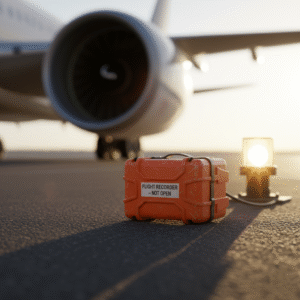
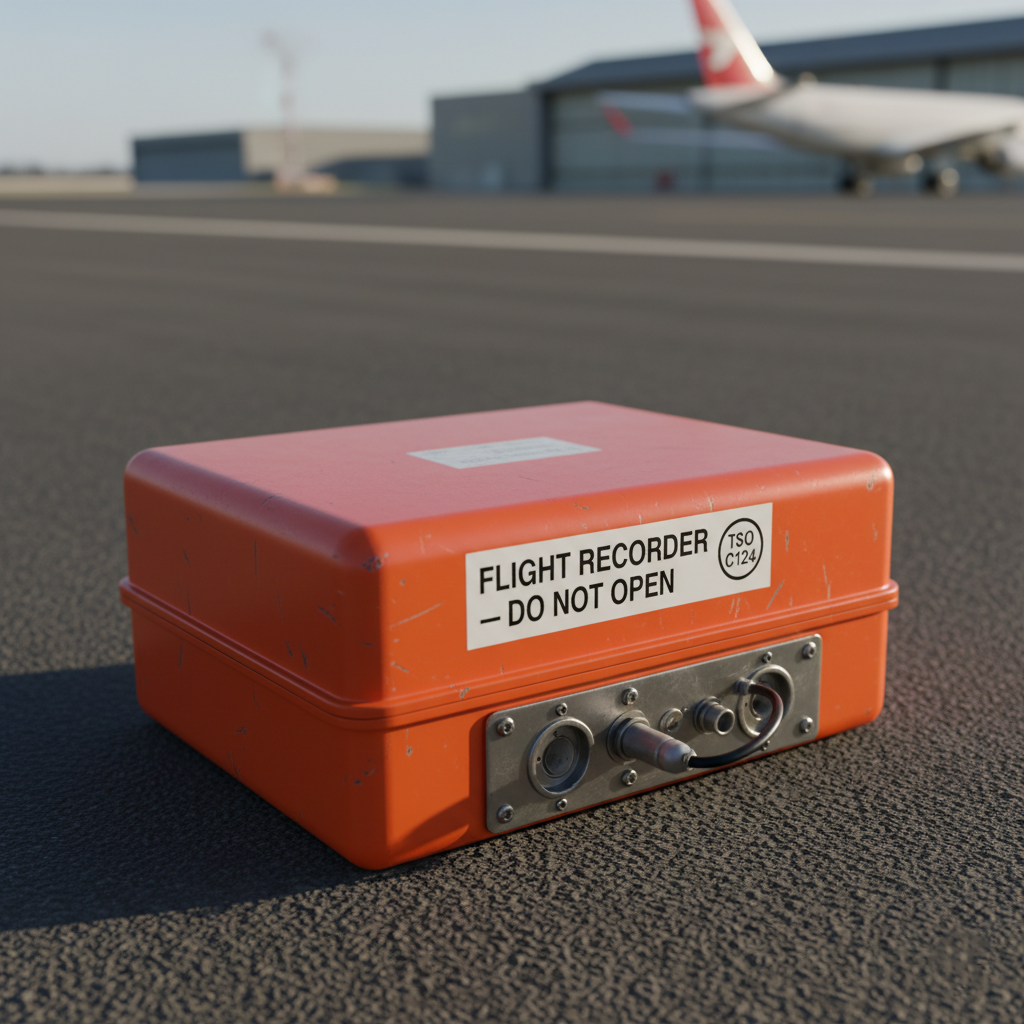
Every time an aircraft crashes or faces a serious emergency, one term immediately dominates the headlines: the black box. Despite the name, this critical component is not black at all. The black box in an aircraft is a brilliant, virtually indestructible, bright orange device—a silent survivor built to withstand the most extreme crashes, fire, and pressure. It records the critical data that helps investigators uncover the crucial truth.
A single black box is actually a pair of essential recorders. Together, they act as the aircraft’s “memory.” The Flight Data Recorder (FDR) captures cold, hard numbers—every parameter of the flight. Meanwhile, the Cockpit Voice Recorder (CVR) records every sound, discussion, and critical alarm from the crew. These two recorders—the FDR and CVR—capture all the data required to reveal the truth of what went wrong. Want to know more about aviation? Visit Skywithwings.com
🧠 The Origin of the Black Box
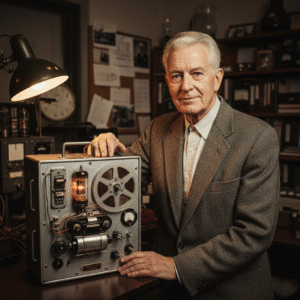
The revolutionary origin of the black box in aircraft traces back to the pioneering 1950s. In that era, the rapid expansion of aviation meant accident investigations were frustratingly reliant on speculation. An Australian scientist, Dr. David Warren, was personally motivated by tragedy: he lost his father in a plane crash when he was a child. Driven by this loss, Dr. David Warren envisioned a device that could effectively record critical information. His vision focused on a system that could record cockpit conversations and precise flight data, ensuring future accidents could be rigorously analyzed with undeniable evidence instead of mere guesswork. His life-saving creation revolutionized aviation safety, becoming the mandatory black box requirement in all commercial aircraft by the 1960s.
🛠️ What’s Inside a Black Box?
What exactly makes the black box such an invincible keeper of secrets? The black box actually houses two critical systems that spring to life the moment the aircraft powers up:
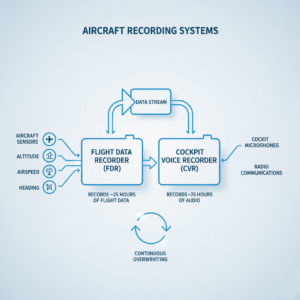
First, there is the workhorse: the Flight Data Recorder (FDR). This device relentlessly records or captures massive amounts of flight data—literally collecting information from hundreds of sensors for up to 25 hours, detailing everything from speed and altitude to every tiny movement of the plane’s controls.
Second is the listener: the Cockpit Voice Recorder (CVR). The CVR records all the critical cockpit sounds for the final two hours of operation, including the pilots’ voices, the chime of alarms, the click of switches, and radio conversations. Both of these recorders are continuously powered and are constantly overwriting old data in real time, ensuring only the most critical hours of flight data and cockpit sounds are preserved in the event of an emergency.
⚙️ How a Black Box in an Aircraft Works?
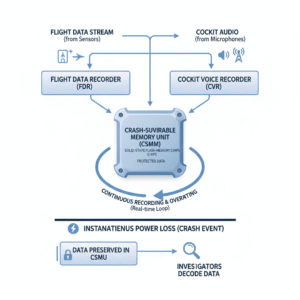
How does the black box actually pull off its miracle of survival and preservation? Both recorders—the Flight Data Recorder (FDR) and the Cockpit Voice Recorder (CVR)—spring to life the instant the aircraft’s power is switched on, acting as continuous digital sentries throughout the flight. Hundreds of sensors and microphones across the plane feed essential data and audio into them in a relentless, seamless loop.
In the terrifying instant of a sudden, catastrophic accident or crash, the plane’s power abruptly ceases. At that exact moment, the precious data from the last critical seconds and minutes of flight is sealed inside the armored core of the device: the Crash-Survivable Memory Unit (CSMU). Because the black box utilizes incredibly durable, reliable solid-state memory chips instead of fragile magnetic tape, the data remains intact. Later, skilled investigators decode the preserved memory from both the FDR and CVR to reconstruct the entire accident sequence, finally revealing the truth of the crash to the world.
🔒 Why the Name “Black Box”?
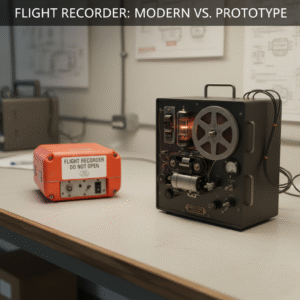
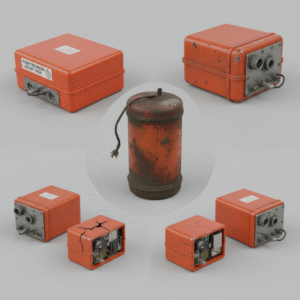
It’s a curious irony—the most famous black box in the world isn’t black at all! In fact, the black box in the aircraft is painted an obvious, almost blindingly bright orange, officially known as “International Orange.” This intense color ensures the device can be easily spotted amid fire damage and twisted metal wreckage.
So, why the name? There are two popular theories:
- One is that early working prototypes were, in fact, black.
- The second theory suggests the name stuck because, in the early days, investigators had to work in dark, secretive labs to analyze the devices—hence the term “black box” for a piece of hidden technology.
🌋 Built to Survive Anything
The black box is not just a recorder; it’s an engineering marvel, truly built to survive anything. It’s constructed like a tiny, armored tank, capable of withstanding forces that would obliterate the plane itself.
- It can survive crashes up to a staggering 3,400 Gs, endure intense fires reaching 1,100 °C for an entire hour, and resist crushing underwater pressure at depths of 20,000 feet.
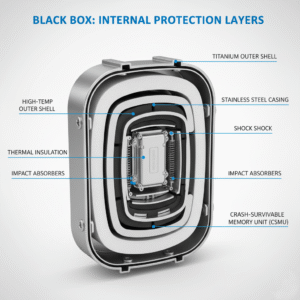
- Its rugged outer shell is made from aerospace-grade titanium or stainless steel, reinforced with multiple layers of insulation and fireproof materials.
Safely nestled deep inside is the crucial memory module, surrounded by advanced heat shields and impact absorbers—all working together to ensure the critical data is protected and ready to tell the final truth.
🌊 Finding the Black Box After a Crash
The search for the black box is the top priority. After a plane accident, locating the device is an urgent mission. Each recorder has an Underwater Locator Beacon (ULB). This beacon activates the moment it touches water.
The ULB starts emitting a distinctive “ping.” It sends a signal once every second. This sound can be detected by sonar equipment. The signal lasts for a critical 30 days. However, deep-sea crashes can delay recovery. Remote terrains also make the mission difficult. The search is often a slow, agonizing process.

🧪 Decoding the Data
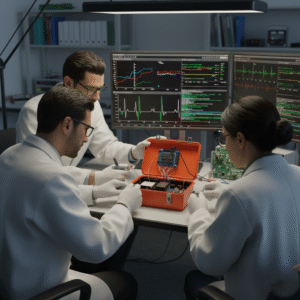
The difficult recovery marks only the beginning. Technicians transport the damaged recorder to specialized labs. Expert engineers begin a meticulous, long process. They carefully clean and thoroughly dry the device. Next, they use custom interfaces. They extract the precious memory data.
Investigators then reach the most critical stage. They actively synchronize FDR and CVR data. They match flight control movements to cockpit audio. Furthermore, they link the exact moment an alarm is triggered to a system failure. This detailed analysis consumes weeks, sometimes months. However, this effort ultimately reveals everything. It shows the pilots’ final actions and words. It pinpoints exactly how the aircraft systems behaved. Thus, the extracted data tells the complete, unbiased story.
📚 Real-Life Cases Solved by Black Boxes
The black box proves its value in real life. It provides answers when a tragedy strikes.
- For instance, Air France Flight 447 crashed in 2009. The FDR showed frozen pitot tubes gave false airspeed readings. This confused the pilots.
- In 2014, Malaysia Airlines MH17 was lost. The CVR confirmed a missile explosion destroyed the aircraft.
- The Lion Air Flight 610 recorder exposed critical faults. It revealed problems with Boeing’s MCAS software.
- In 1996, the CVR from TWA Flight 800 proved valuable. It helped investigators rule out a bomb or missile strike. Instead, they focused on the center fuel tank.
- Also, the Germanwings Flight 9525 CVR told a chilling story. It revealed the co-pilot deliberately caused the fatal crash.
These findings sparked immediate global safety reforms. Every black box investigation ultimately prevents future tragedies. It makes flying much safer for everyone.
🚀 The Future of Black Boxes
Aviation technology never stops advancing. Consequently, the next generation of flight recorders looks incredible. Soon, for example, real-time data streaming will become standard. This constantly sends information to ground servers.
Moreover, another major innovation involves deployable recorders. These automatically eject from the aircraft during impact. Furthermore, future underwater pingers will last for 90 days. Therefore, they provide much longer locator signals. In addition, enhanced storage capacity will capture thousands of parameters.
Ultimately, we may reach a pivotal point. Investigators will thus no longer search for a black box. Instead, the crucial data will already be safe in the cloud. Consequently, this change will bring instant answers and faster reforms.

🧍♂️ Why Black Boxes Matter to Passengers
For travelers, the black box remains invisible. Nevertheless, it acts as the ultimate guardian of flight safety. Every key change in aviation procedures starts here. For example, improved pilot training stems from past recorder data. Equipment upgrades also rely on those facts.
Therefore, remember this next time you fly. A black box watches silently somewhere inside your aircraft. It ensures your flight is safer than the last one. Thus, this device transforms tragedy into trust.

🙋♂️ Frequently Asked Questions (FAQs)
1. What is a black box in an aircraft used for?
A black box records flight and cockpit data, helping investigators understand the cause of accidents and improve aviation safety.
2. Is the black box really black?
No, it’s painted bright orange to make it easier to locate after an accident.
3. Where is the black box located in an aircraft?
It’s usually installed at the rear of the aircraft, where chances of survival in a crash are higher.
4. How long can a black box record data?
The Flight Data Recorder (FDR) records 25 hours of data, and the Cockpit Voice Recorder (CVR) records 2 hours of audio.
5. Can black boxes be destroyed?
They are built to survive crashes, fires, and underwater pressure — but in extremely catastrophic conditions, partial data loss can occur.
6. How long does a black box’s beacon last underwater?
The beacon transmits pings for about 30 days, though newer models can last up to 90 days.
7. Can black boxes record video?
No, they only record audio and data — not cockpit visuals — due to privacy and safety reasons.
8. How long does it take to analyze a black box?
Depending on damage and complexity, decoding can take from a few days to several months.
✈️ Conclusion
Ultimately, the black box is more than just a machine. It acts as a storyteller of truth. Moreover, it stands as the ultimate guardian of safety. This device is why modern air travel is so reliable. Dr. David Warren’s early invention started a revolution. Consequently, this technology remains aviation’s most critical tool today. Therefore, every time you board a plane, remember this fact. You fly safer because past black boxes taught us crucial lessons.