
Introduction
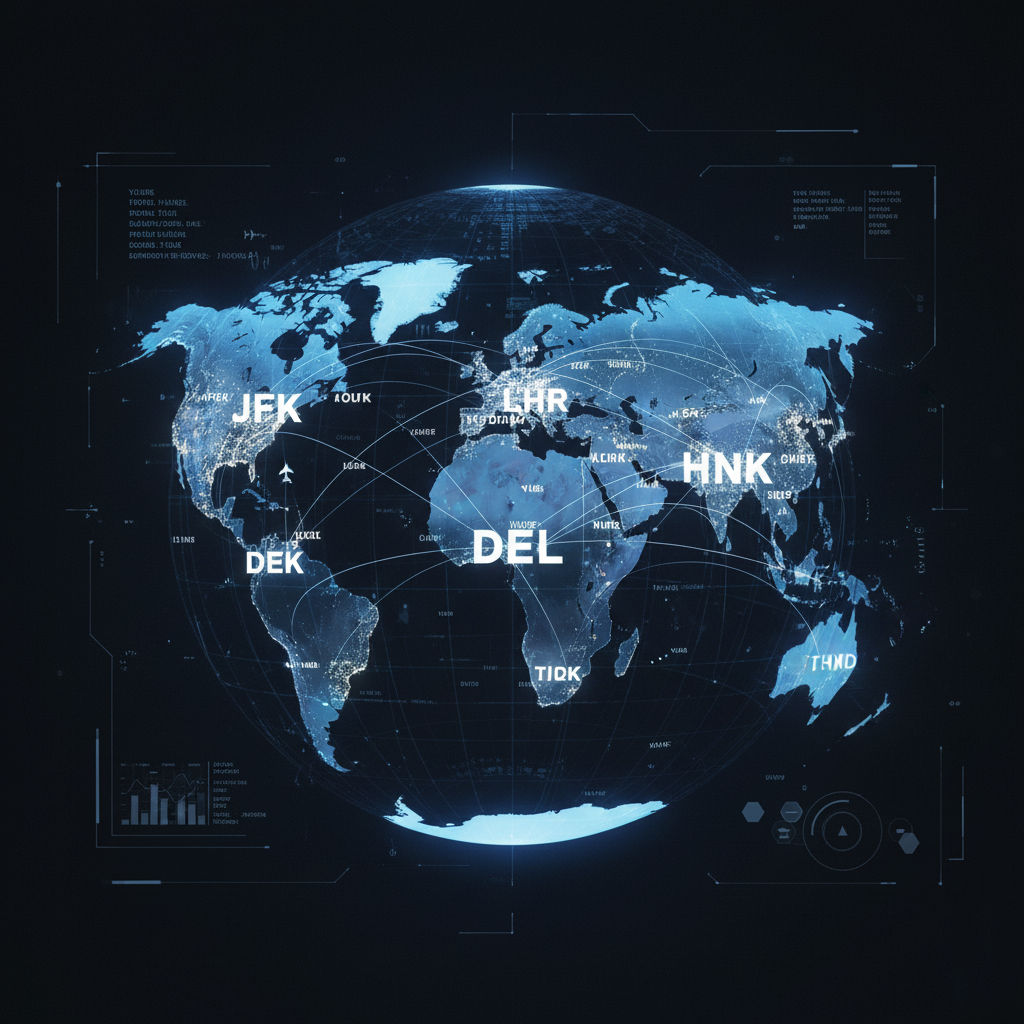
Have you ever wondered about the hidden language of the sky? Every time a ticket is booked or baggage is checked, those three-letter codes—like DEL, LAX, or DXB—are clearly visible. Consequently, these Airport Codes function as the essential global shorthand that efficiently connects every corner of the vast aviation world. In essence, an airport’s secret identity is communicated through these codes, which are instantly recognized by ground crew and pilots alike.
However, what is the true story behind this crucial system of codes? Who is responsible for their assignment, and how are the decisions made? Specifically, why is it that some codes make perfect sense—for example, Salt Lake City is SLC—while others seem completely random and confusing? Therefore, we will now dive into the fascinating world of Airport Codes to discover how this essential organizational system makes seamless global air travel possible across the entire planet.
Know more about aviation at Skywithwings.com.
🌍 What Are Airport Codes, Really?
Airport Codes are short, unique nicknames for airports. These three-letter identifiers prevent aviation chaos. They are essential for tickets and baggage handling.
Airports actually have two different nicknames. This depends on who uses them.
IATA Codes (For Passengers)
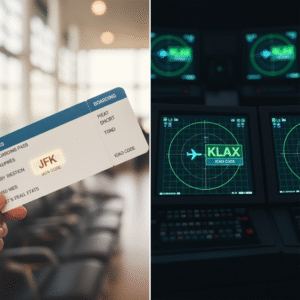
These are the simple, three-letter codes. You see them on your ticket and baggage tag. Airlines use IATA codes for commercial purposes.
- Examples: DEL (Delhi), LAX (Los Angeles), DXB (Dubai).
ICAO Codes (For Pilots)
Air traffic controllers and pilots use these. They are four-letter codes. Professionals use them behind the scenes. They need this extra letter for precision.
- Examples: VIDP (Delhi), KLAX (Los Angeles), OMDB (Dubai).
The key takeaway is simple: You look at the IATA code on your ticket. Pilots use the ICAO code to fly.
🧭 How Did These Codes Start? A Look Back
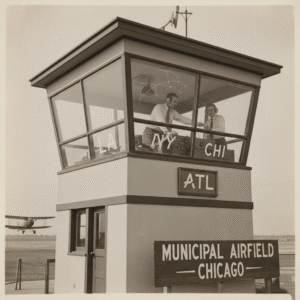
The whole system of airport codes actually started way back in the 1930s, right as flying was starting to boom.
In the very beginning, U.S. airports took the easy route: they just borrowed the two-letter codes that weather stations already used. But as planes started crossing oceans and global travel exploded, those two-letter codes just weren’t enough. That’s when the three-letter code became the worldwide standard.
Two big international groups stepped in to make sense of the chaos:
- IATA (The Airline Boss): The International Air Transport Association took the job of making sure every single airport got a unique three-letter ID (like LAX). This is the code for the commercial side—the tickets and baggage.
- ICAO (The Pilot Boss): Around the same time, the International Civil Aviation Organization created the more technical four-letter system. Pilots and air traffic control use these codes for critical operational stuff.
The result? This dual system was a stroke of genius. It ensured that airlines, pilots, and controllers all had the perfect language to communicate smoothly and safely.
🏙️ Where Do These Codes Come From? The Naming Game
Ever look at an airport code and wonder, “What were they thinking?” Well, there’s actually a fascinating logic behind almost every single one! Think of it like a puzzle where they use a few clever patterns to make the names stick:
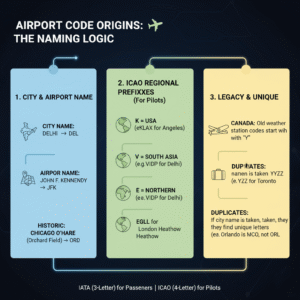
1. The Obvious Ones: Using the Name
When they can, they keep it simple and just use the city or the airport’s full name.
- The City Name: They often use the first three letters of the city
- DEL name – Delhi
- LON – London (This code is actually used when you search for flights to any London airport, like LHR or LGW).
- The Airport Name: If the airport has a famous name, they use the initials.
- JFK – John F. Kennedy (New York)
- CDG – Charles de Gaulle (Paris)
This is where it gets fun! Some codes make zero sense until you know the secret history.
- ORD -Chicago O’Hare: Why not CHO? The code is a nod to its original name, Orchard Field.
- YYZ – Toronto Pearson: Why all those ‘Y’s? This code is a relic from Canada’s early days, when all their codes started with a ‘Y’ for weather stations!
3. The Pilot’s Clue: ICAO Prefixes
Remember the four-letter ICAO codes the pilots use? The first one or two letters always tell them what region of the world they are in—like a geographical cheat sheet!
- V –V for South Asia (e.g., VIDP for Delhi)
- K- K for the USA (e.g., KLAX for Los Angeles)
- E – E for Northern Europe (e.g., EGLL for London Heathrow)1
So, the next time a code looks weird, chances are it’s either an old secret or a regional clue!
✈️ IATA vs ICAO: The Two Systems Explained
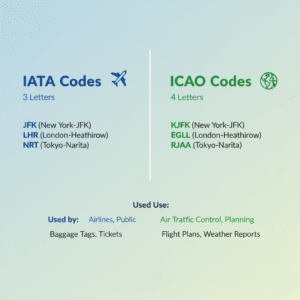
While both systems identify airports, their purposes differ:
| Feature | IATA Code | ICAO Code |
|---|---|---|
| Format | 3 letters | 4 letters |
| Example | DEL, JFK, DXB | VIDP, KLAX, OMDB |
| Used by | Airlines, passengers | Pilots, ATC, flight planning |
| Focus | Commercial use | Operational and regulatory use |
Decoding the Airport Alphabet: A Global Tour
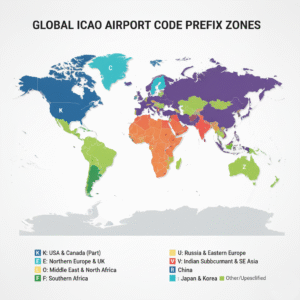
Instead of a confusing jumble of letters, think of these codes as geographic signals for the people who actually run the skies—air traffic controllers and pilots!
🏔️ North America: The Pioneers
- The Big ‘K’ (USA): When you see a “K” leading an ICAO code (like KLAX or KJFK), it’s the Universal Sign that “We are in the Lower 48!” It’s a clean, simple system for the U.S.
- The Canadian ‘C’ and ‘Y’: Canada keeps it unique. Their ICAO codes often start with C (CYYZ), and their friendly, public-facing IATA codes frequently start with Y (YYZ for Toronto), giving them a distinct Northern identity.
🌆 Europe: The Continental Divide
Europe’s codes are like a map written in letters, generally running from Northwest to Southeast:
- The British ‘E’: “E” often signifies the North Atlantic and the UK (e.g., EGLL for London Heathrow).
- The Southern ‘L’: Head south toward the Mediterranean, and you hit the ‘L’ zone (like LIRF for Rome or LFPG for Paris).
- The Eastern ‘U’: As you move east toward Russia and Eastern Europe, the ‘U’ codes take over.
🌏 Asia: A Vast Alphabet Soup
Asia is so huge, its codes have to be specialized:
- The Subcontinent ‘V’: Codes starting with ‘V’ usually point to the Indian Subcontinent and parts of Southeast Asia (e.g., VIDP for Delhi).
- The Island ‘R’: The ‘R’ region covers the island nations and peninsulas of Japan and Korea (e.g., RJTT for Tokyo Haneda).
- The Mainland ‘Z’: ‘Z’ is the distinct marker for the massive airspace of China (ZBAA for Beijing).
🌍 Middle East & Africa: The Gateway Codes
These regions use specific markers to delineate the great transcontinental routes:
- The Middle Eastern ‘O’: The ‘O’ is the letter of the Gulf states, signaling a key hub for global travel (e.g., OMDB for Dubai).
- The Southern African ‘F’: Down in the Southern Hemisphere, the ‘F’ codes mark the major airports of the region (e.g., FAOR for Johannesburg).
It’s a brilliant system: The first letter tells the air traffic controller where in the world the flight is coming from or going to!
When Airport Codes Get a Sense of Humor 😂
Think those four-letter ICAO codes are all business? Think again! Beneath the surface of serious flight plans and navigation charts, a few airports have codes that are pure gold—or, at least, pure comedy. They make aviation geeks smile!
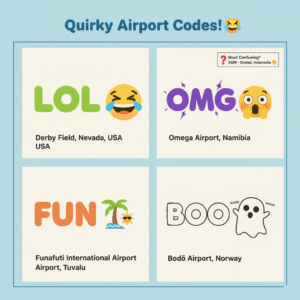
- LOL – Derby Field, Nevada, USA: This one truly earns the chuckle emoji 😄. Imagine a pilot radioing in: “We are approaching L-O-L, ready for landing.” The code has an unexpected, internet-age twist.
- OMG – Omega Airport, Namibia: For a pilot, getting clearance to “O-M-G” might genuinely trigger that surprised reaction 😲. This remote Namibian airfield gets a code that perfectly captures a moment of shock or excitement.
- FUN – Funafuti International Airport, Tuvalu: This code is a tropical invitation! You know your vacation is starting right when your ticket says your destination is FUN 🌴. It’s perfectly fitting for this tiny, joyful Pacific island nation.
- BOO – Bodø Airport, Norway: Perfect for Halloween or a spooky flight, Norway’s Bodø Airport gives us a little fright with BOO 👻. It’s a short, chillingly simple code for a northern destination.
And the ironically challenging winner?
- DUM – Dumai Airport, Indonesia: This code is the ultimate aviation irony. For a pilot navigating complex airspace and procedures, being asked to fly to the destination of DUM (Dumai) is certainly confusing! 🤯
The Quiet Power of Airport Codes 🛄
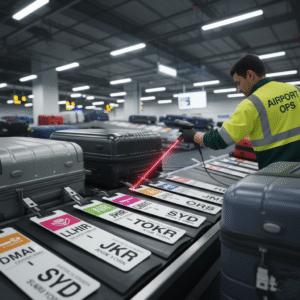
Global air travel needs these codes. Otherwise, everything would be chaos. These simple codes streamline your entire trip. They manage everything from booking to bag tracking.
Think about it: You check your bag in Delhi (DEL). Your flight goes to Dubai (DXB). The whole baggage system relies on those three letters. A simple mix-up means disaster. In short, your bag could end up halfway around the world! Clearly, these tiny codes are essential.
The Secret Language of the Sky 🧠
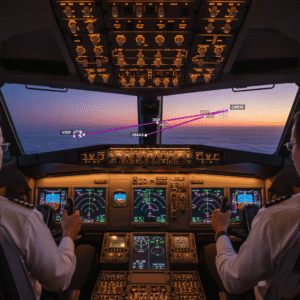
Pilots and controllers rely on ICAO codes. These codes are vital for safety. Flight plans use them heavily. Communication logs are based on them. Navigational systems all reference them.
- Picture this: A pilot flies from Delhi (VIDP). The destination is Dubai (OMDB). The flight route is filed using only these ICAO codes.
Consequently, every control tower knows the route. They know the exact origin. They know the exact destination. This prevents dangerous confusion. Simply put, these codes run the entire flight operation.
Naming the New Hubs 🏗️
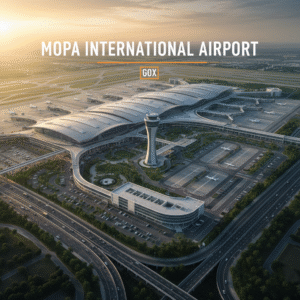
A new airport needs new codes. Therefore, both IATA and ICAO assign them. They usually try to be logical. They often use the city name or airport name letters.
However, preferred codes are sometimes taken. This forces creative alternatives.
For example:
- Istanbul’s new airport is IST. It replaced the old one, which was ISL.
- Furthermore, Goa’s new Mopa Airport needed a code. It ended up with GOX. The older Dabolim Airport keeps GOI. They must be unique. Consequently, the code process is a mix of logic and necessity!
Top Five Facts About Airport Codes 🧾:
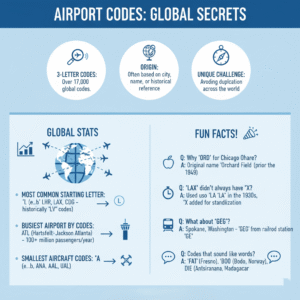
- Sheer Volume: There are many codes out there. In fact, over 17,000 airport codes exist worldwide.
- Metropolitan Tags: Some large cities share one code. For example, NYC covers JFK, LGA, and EWR airports.
- Stability is Key: Codes rarely ever change. This happens even if the airport is renamed. Therefore, the system stays reliable.
- Honoring Icons: Some codes honor famous people. Specifically, they include JFK and CDG (Charles de Gaulle).
- The Canadian Mystery: Canada’s “Y” prefix is historical. Originally, it came from old weather station identifiers.
Airport Codes: The Passport to Global Stories
It’s easy to see an airport code like JFK, CDG, or SYD as just three letters on a ticket, but they are so much more.
In our connected world, these codes are the beating heart of global travel.
- For the Passenger: They are the first hint of an adventure—a mental bookmark for a long-awaited reunion or the start of a new exploration. They represent a destination more than a location.
- For the Pilot: They are the critical anchors of their journey—a precise, unambiguous language spoken across every flight deck, control tower, and ground crew, ensuring safety and precision above all else.
- For the Aviation Enthusiast: They are the history books of flight—each code often hiding a story of a city’s pioneer, a historical field, or a local landmark.
Airport codes don’t just mark a place; they unite the entire ecosystem of flight—passengers dreaming of the future, pilots navigating the present, and airlines connecting the world—all speaking that single, universal language of aviation. They are truly the symbols of global connectivity.
The True Meaning of the Code
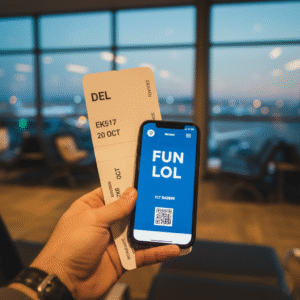
From the towering hubs of JFK and DXB to the charmingly named airports like FUN (Funafuti, Tuvalu) and LOL (Lola, Guinea), those three letters are far more than just technical abbreviations. They are three-letter stories.
They encapsulate decades of history, clever geography, and the profound, enduring human desire to bridge distances and connect our world. Every code represents a starting point, a destination, a reunion, or an adventure waiting to happen.
So, the next time your eyes drift across your boarding pass, don’t just see a code. Take a second look. See the evolution of flight, the synchronized teamwork of thousands, and the universal dream of soaring contained in those simple, powerful characters.
They are the silent, steadfast language of a truly connected planet.
✈️ FAQs on Airport Codes
1. Who assigns airport codes?
IATA assigns the 3-letter commercial codes, while ICAO assigns 4-letter operational codes.
2. Why do some codes seem unrelated to the city name?
Older weather station codes or previous airport names were used when airports were established.
3. Can two airports have the same code?
No. Every airport has a unique IATA and ICAO code.
4. Do heliports and military bases have codes?
Yes, but they usually only have ICAO codes, not IATA codes.
5. How many airport codes exist worldwide?
There are more than 17,000 recognized codes across all continents.